

.png)
Perth Water Filtration Service Before You Buy

Perth's tap water meets every health standard the Australian Drinking Water Guidelines set. That's not really the question most homeowners are asking, though. The real question is why the water tastes different in Two Rocks than it does in the hills, why kettles scale up faster in some suburbs than others, and whether a Perth water filtration service is actually solving a problem your household has, or just selling you a box under the sink. This article works through what's genuinely in Perth's water, what the different filter types do, and what to check before you commit to a filtration system.
What's Actually in Perth's Water
Perth doesn't draw from one source. Water Corporation blends groundwater from the Gnangara and Jandakot aquifers, desalinated seawater from two large plants, water from dams in the hills, and a smaller amount from a groundwater replenishment scheme. Roughly 40 percent of supply comes from groundwater in a typical year, with desalination making up around a third and the remainder split between dams and replenished groundwater. That blend shifts by season and by suburb, and it's the reason two houses twenty minutes apart can have noticeably different-tasting water.
Groundwater carries more dissolved minerals, which means harder water and higher total dissolved solids (TDS). Desalinated water is close to the opposite: very soft, low in minerals, and often described as tasting flatter. Suburbs that draw mostly from the Gnangara Mound, especially in the north, end up with the hardest water in the city. Areas fed more heavily by desalination or the hills dams tend to run softer.

Perth Water Sources at a Glance
Source | Approx. Share of Supply | Typical Hardness | Typical TDS |
Groundwater (Gnangara/Jandakot) | ~40% | Hard to very hard | Higher |
Desalinated seawater | ~30-35% | Very soft | Low |
Surface water (hills dams) | ~20-25% | Soft to moderate | Low to moderate |
Groundwater replenishment | ~5-8% | Low mineral (treated) | Low |
Water Corporation tests around 70,000 samples a year across roughly 92 groundwater sources, 43 surface water sources, and the desalination network, producing more than 365,000 individual lab results. None of the health-related parameters have exceeded the guideline limits in recent reporting, so the compliance side of things is well covered.
Hardness: The Part Most People Actually Notice
Hardness is measured in milligrams of calcium carbonate per litre, and it's the single biggest source of complaints about Perth water, mostly because it shows up as kettle scale, cloudy glassware, and soap that won't lather properly. The Australian guideline treats 200 mg/L as an aesthetic threshold, not a health limit, but plenty of Perth suburbs sit near or above it.
Water Hardness by Perth Suburb (mg/L CaCO3)
Dwellingup (soft)        ███              29
Perth average            ██████████       96
Yanchep (very hard)      ████████████████████  204
Two Rocks (very hard)    ██████████████████████ 228
ADWG aesthetic guideline ████████████████████   200 (reference line)
Two Rocks and Yanchep, both fed heavily by Gnangara groundwater, sit above the aesthetic guideline. The city-wide average lands around 96 mg/L, which counts as moderately hard, while a suburb like Dwellingup, drawing on softer sources, barely registers on the same scale.
Insight: Most people shopping for a filtration system start from "what does Perth water contain" instead of "what does my suburb's water contain," and that's backwards. A carbon filter that handles chlorine taste in a desalination-heavy suburb won't touch the hardness problem in a groundwater-heavy one. Knowing your actual local blend, which Water Corporation publishes by supply zone, matters more than any general fact about Perth as a whole.
Chlorine, Fluoride and PFAS
Perth uses free chlorine rather than chloramine to disinfect its water. This matters for filter shopping because free chlorine breaks down more easily than chloramine, so a standard carbon block filter removes it effectively, whereas cities on chloramine often need a more specialised filter to get the same result.
Fluoride sits between 0.6 and 1.1 mg/L across the network, in line with the National Health and Medical Research Council's recommended range for dental health, and well under the 1.5 mg/L safety ceiling. Perth has fluoridated its supply since the 1960s.
PFAS, a group of manufactured chemicals sometimes called "forever chemicals," has been detected in some Perth-area water sources, and Water Corporation reports that bulk supply meets the updated 2025 NHMRC guideline levels for PFOS, PFHxS and PFOA. Detection isn't the same as a breach, but it's the reason PFAS removal has become one of the more common questions people bring to a water filtration service, particularly families with young children or anyone drawing water from a private bore near an industrial or defence site.
Choosing the Right Type of Water Filtration System
Not every filter does the same job, and the type that suits a Dwellingup household with soft water is rarely the right fit for a Two Rocks household dealing with hardness and scale. The main categories are worth understanding before you buy.
Filter Types Compared
Filter Type | Removes Well | Best Suited For |
Basic carbon jug or tap filter | Chlorine taste and odour | Renters, apartment owners, quick low-cost fix |
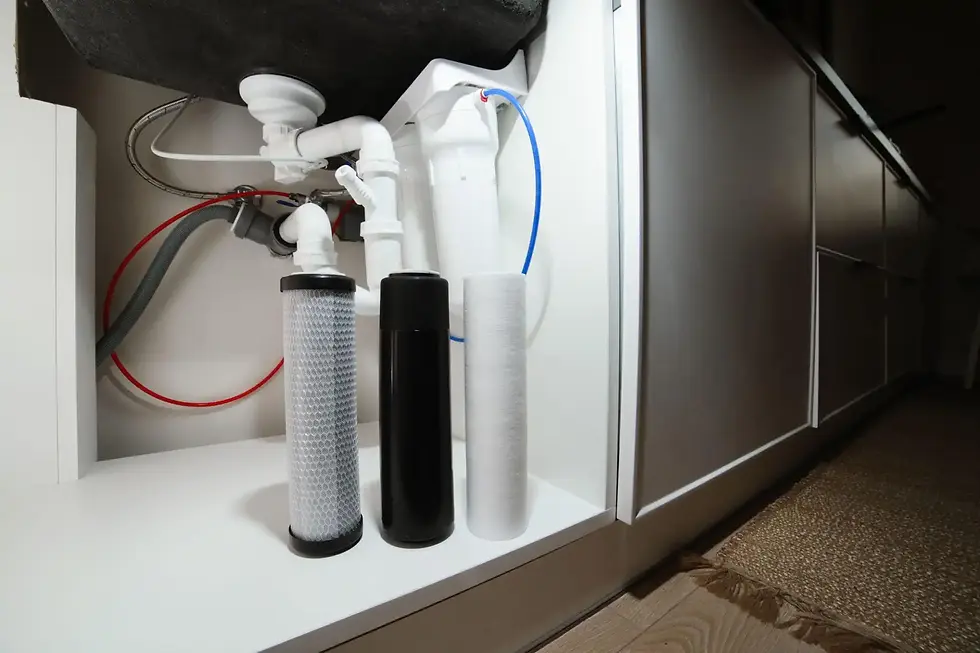
Under-sink filtration systems | Chlorine, sediment, some taste and odour compounds | Homeowners wanting a dedicated drinking tap |
Reverse osmosis (under-sink) | Hardness minerals, TDS, PFAS, most dissolved contaminants | Families concerned about PFAS or high-TDS suburbs |
Whole-house filtration | Sediment and chlorine at every tap in the home | Hard-water suburbs, protecting appliances and plumbing |
Apartment owners generally get the most value from a simple under-sink or tap-mounted unit, since whole-house systems usually aren't practical or approved in a strata building. New home buyers building in a hard-water suburb often plan a whole-house system into the build from the start, which avoids retrofitting pipework later. Rural and regional residents on bore water face a different set of issues again, often needing sediment and UV treatment alongside a standard filter, since bore water isn't part of the reticulated network at all.

Eco-Friendly Water Filtration Options
Filter cartridges generate waste, and reverse osmosis systems use more water than they output as filtered water, which puts some households off the technology altogether. Eco-friendly water filtration has become a real category of its own in response. Options include filters with recyclable or refillable cartridges instead of sealed disposable units, systems designed to cut reject-water ratios closer to 1:1 instead of the older 3:1 or 4:1 standard, and carbon block filters made from coconut shell rather than mined materials. None of these fully solve the waste question, but they reduce it meaningfully compared with older filter designs, and it's a fair thing to ask an installer about directly.
What a Good Perth Water Filtration Service Should Offer
A proper water filtration service does more than sell a unit off a shelf. Before signing anything, it's worth asking whether the provider tests your specific tap water rather than quoting off general Perth averages, since hardness and TDS vary so much by suburb. A reasonable provider explains which contaminants their system actually targets rather than making blanket safety claims, and offers a genuine maintenance and cartridge-replacement schedule instead of a one-off installation with no follow-up. Warranty terms and local support also matter more than they might seem to at the point of sale, particularly for reverse osmosis systems, which need periodic membrane replacement to keep performing.
Getting Started
The most useful first step is checking your own supply zone's hardness and TDS data through Water Corporation, rather than assuming the citywide average applies to your street. From there, matching the filter type to the actual problem, whether that's chlorine taste, scale, PFAS, or all three, saves both money and disappointment. Families, new home buyers, rural residents on bore water, and apartment owners are all solving slightly different problems, and the right water filtration system reflects that rather than a generic install.
FAQs
Is Perth tap water safe to drink?
Yes. Water Corporation's supply meets all Australian Drinking Water Guidelines for microbiological and chemical safety, verified through tens of thousands of samples each year. Some suburbs have harder or higher-TDS water than others, which affects taste and appliance scale rather than safety.
Why does Perth's water taste different depending on suburb?
Perth blends groundwater, desalinated seawater, and dam water in different ratios by supply zone. Groundwater-heavy suburbs taste more mineral and feel harder, while desalination-heavy areas taste softer and flatter. The mix can also shift seasonally.
Do I need a whole-house filter or just an under-sink system in Perth?
It depends on the issue. Under-sink filtration systems suit drinking and cooking water in most homes. Whole-house filtration is worth it mainly in hard-water suburbs like Yanchep or Two Rocks, where scale affects pipes, hot water systems, and appliances too.
Does a Perth water filtration service remove PFAS?
Basic carbon filters reduce some PFAS but not reliably. Reverse osmosis systems are the most effective residential option for PFAS reduction, along with hardness and TDS. Ask any installer specifically what their system is rated to remove.
How much does a water filtration system cost in Perth?
Basic tap or jug filters start under $100. Under-sink carbon systems typically run a few hundred dollars installed. Reverse osmosis and whole-house systems cost more upfront, generally in the low thousands, with ongoing cartridge or membrane replacement costs.


