


Fitzroy Crossing Bore Water Filter Maintenance

Bore water filter maintenance is easy to put off until the taps run slow or the water turns rusty. Out in the Kimberley that gets expensive fast. This guide covers what to check, how often, and which parts of a bore water setup need the most attention.
Quick answer: backwash iron filters every 2 to 4 weeks, change sediment cartridges every 3 to 6 months (monthly if the bore is sediment heavy), replace the UV lamp every 12 months, and test the water at least once a year.
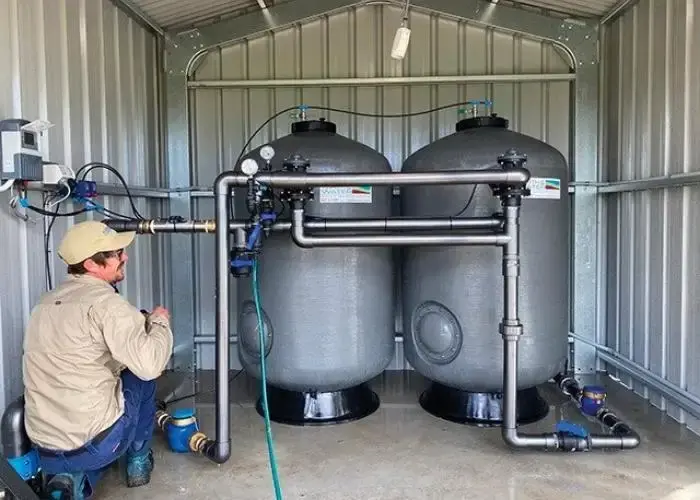
Why bore water filter maintenance matters in Fitzroy Crossing
Bore water comes straight from the ground, so it carries whatever the ground holds. WA Health says it can contain bacteria, iron and salt, and shouldn't be drunk unless it has been tested and treated. The problem is real in the Fitzroy Valley. At Kadjina, about 100 km south-west of Fitzroy Crossing, Water Corporation built a new treatment plant to remove naturally occurring iron and manganese from groundwater.
Fitzroy Crossing conditions | Figure | What it means for your system |
Hottest month (November), mean maximum | 40.8 °C | Water use climbs, so cartridges can wear sooner |
Mean annual rainfall | 686.4 mm | Most of it falls in the wet season |
Wettest month (January), mean rainfall | 192.6 mm | Check the bore cover and slab after heavy rain |
Figures are from the Bureau of Meteorology's Fitzroy Crossing Aero station.
An overdue filter can start growing bacteria itself. So skipping a change isn't a saving, it just moves the cost somewhere else.
Your bore water filter maintenance schedule
Use the schedule below as a starting point. Bore water varies a lot from one property to the next, so adjust it after your first test.
Component | How often | Notes |
Sediment pre-filter | Every 3 to 6 months | Sediment-heavy bore water may need monthly changes |
Carbon block | Every 6 to 12 months | Six months is a safe baseline |
Iron filter backwash | Every 2 to 4 weeks | More often if iron is high |
Iron filter media | Every 4 to 6 years | Cost varies by system size |
UV lamp | Every 12 months (about 9,000 hours) | Clean the quartz sleeve at each change |
Housings and O-rings | At least once a year | More often with bore water |
Water test (NATA lab) | At least once a year | Needed if bore is your only supply |
Chart: Relative maintenance load by component
Under-sink carbon       ██████       Low
Whole home housings     ███████      Low–Moderate
UV unit                 ████████     Moderate
Sediment pre-filter     █████████    Moderate–High
Iron filter             ██████████   High
Iron + heavy sediment   ████████████ Very High
How to read it: longer bars mean more frequent hands-on attention, based on the change and cleaning intervals in the table above. It's a relative guide, not measured data.
Insight: a UV lamp that still glows may not be doing its job. Lamps fade to about 60% of their original output over a year, and UV also needs clear water to work. So a clogged sediment filter in front of it weakens the whole system.

Sediment and iron filter care
Sediment pre-filters
The sediment stage protects everything behind it. If flow drops, check this cartridge first. Heavy-sediment bore water can clog it in weeks, not months.
Iron filters
Backwash every 2 to 4 weeks as a rule, and more often if the iron level is high. Red-brown staining on taps, tiles or paths is the usual warning sign. Replace the filter media every 4 to 6 years, and have the whole unit inspected once a year.
Housings and O-rings
Clean and sanitise the housings at least once a year. Hand-tighten them, because a metal wrench can crack the plastic. Swap any cracked O-ring and don't reuse old cartridges, even if they look okay.
UV unit care for bore water
UV disinfection targets bacteria, but it only works if you look after it. Replace the lamp every 12 months, or about 9,000 hours. Clean the quartz sleeve at the same time with a cloth and mild acid such as vinegar, then rinse. Replace the sleeve if it is scratched or cracked. Turn off the power and wait about 10 minutes before opening the unit, and wear gloves so skin oils don't mark the lamp. Leave it running too. Switching a UV lamp on and off all the time shortens its life.
UV leaves no protection in your pipes. For drinking water, WA Health says chlorination is the most reliable way to remove microbes, so ask a specialist what suits your supply. Just Water Co's bore and tank water systems pair UV disinfection with specialised pre-filtration.

Whole home water and under-sink filtration systems
Whole home water systems treat every tap, shower and laundry. Under-sink filtration systems polish the drinking water at the kitchen. Some properties run both, a whole home water system at the main and an under-sink unit for drinking and cooking. Keep carbon cartridges fresh every 6 to 12 months and change all stages on one date each year.
A yearly water filtration service takes the guesswork out. Just Water Co's Care Plan covers scheduled filter changes every 6 or 12 months (depending on your system), flow and pressure checks and reminders. Eco-friendly water filtration helps too. Choice reports bottled water can cost up to about 2,000 times more than tap, and it estimates 60% of PET bottles go to landfill. A well-kept water filtration system gives you drinking water on tap with far less plastic.
Bore water filter maintenance tips by household type
Families and homeowners
Pick one date every year and change every stage of your water filtration system together. Write it on the calendar, or sign up for reminders. It also supports eco-friendly water filtration by cutting bottled water use.
New home buyers
Ask the seller for the system model, install date and last test results. If nobody knows, test the water and replace every stage once. Then start your own record.
Rural and regional residents
Test at least once a year if bore water is your only supply. Check the wellhead cover and slab after heavy wet-season rain, and shorten sediment changes if the water looks cloudy.
Apartment owners
If your unit is on a reticulated supply, bore water maintenance doesn't apply. Under-sink filtration systems still suit apartments well, but check with your body corporate before any plumbing changes.
FAQs
How often should bore water filters be changed?
Sediment filters usually need changing every 3 to 6 months, and carbon every 6 to 12 months. Heavy-sediment bores can need monthly sediment changes. UV lamps go every 12 months. Your own water quality sets the real schedule, so test it and adjust. Ask your installer for a bore-specific schedule.
How do I know if my bore water filter needs replacing?
Falling flow is the first sign, often from a clogged sediment cartridge. Other signs are a return of taste and odour, red-brown staining, or leaks after servicing. A filter that looks dirty or has swollen in its housing is already overdue. Test the water if you're unsure, and book a service.
Is bore water safe to drink after filtering?
Not automatically. WA Health says bore water shouldn't be drunk unless it has been tested and treated for that use. Get a lab test from a NATA-registered laboratory, then ask a specialist about pre-filtration, UV and chlorination. If it's your only supply, retest at least yearly. Never assume filtered means safe.
How often should a UV light be replaced?
Replace the lamp every 12 months, or about 9,000 hours. UV lamps don't burn out suddenly, they fade to roughly 60% of their original output, so a glowing lamp can still be too weak. Clean the quartz sleeve at every change. Mark the date on a calendar so it doesn't slip.
How do I remove iron from bore water?
Iron filters oxidise dissolved iron and trap it as solids. Backwash them every 2 to 4 weeks, more often if iron is high, and replace the media every 4 to 6 years. A sediment pre-filter in front protects the media and keeps flow steady. Ask for a water test first.
Need a water filtration service for your bore in Fitzroy Crossing? Just Water Co is WA owned and operated and lists the Kimberley, including Fitzroy Crossing, in its service area. It installs bore and tank water systems, whole home water systems and under-sink filtration systems, with interest-free payment plans through Humm and Zip. Book your free water test at justwaterco.com.au or call 08 9129 4470.


